Entries Tagged 'Razor History' ↓

The Marketing Powerhouse that was and still is the Gillette Safety Razor Company, part 4

Here is the fourth in this fascinating series of articles by Matt Pisarcik of Razor Emporium:

The One-Piece Razor

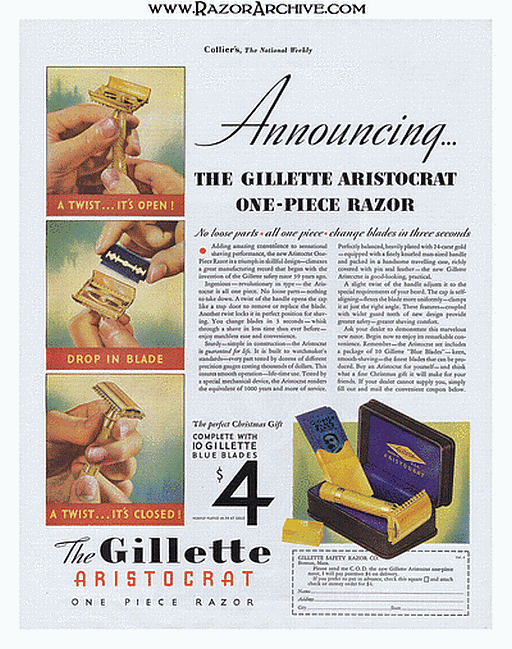
The NEW razor was short lived and made way for the razors that most people know Gillette for: the One-Piece. Debuting in 1934, the Aristocrat was a model name used twice already that now carried a newly unveiled design. Using a twister knob at the bottom, engineers at Gillette were able to develop a razor model that could accommodate a double edge blade in a concise, one-piece style. One of the most interesting aspects of this consolidated design however was all of the marketing and gimmicks that sprung up around it.

The initial advertisements played up the convenience while using catch-phrases such as: “A Twist! It’s open, A Twist! It’s closed.” The ads promoted the idea that you no longer had loose parts or trouble loading a blade, basically evoking the premise of convenience and ease. Later into the 1940’s Gillette even put out a new blade dispenser to work in combination with their razors. At first, they were simply telling consumers to remove the blade and place it into the opened razor bay, but later modified the actual razor to allow the blade to hook onto the notched center bar. This scheme of  a the disposable product being closer affiliated with the “Freebie” product increased customer loyalty of razor owners choosing genuine Gillette blades and not using third-party or off brand competitors.

Even while Gillette was producing this great new design, they still continued on with 3 piece style razors all the way into the 1960’s. They never phased out these inexpensive models because they were always after blade sales. However people would buy their razor blades, Gillette sold them a razor to do so. The idea of having a product range that all drove the same revenue-generating profit center (razor blades) is a marketing and business model that not only is successful, but also wide-spread in our modern day and age.

Advert images from Razor Archive.

The Marketing Powerhouse that was and still is the Gillette Safety Razor Company, part 3

Here is the third in this fascinating series of articles by Matt Pisarcik of Razor Emporium:

1920’s: The New Improved

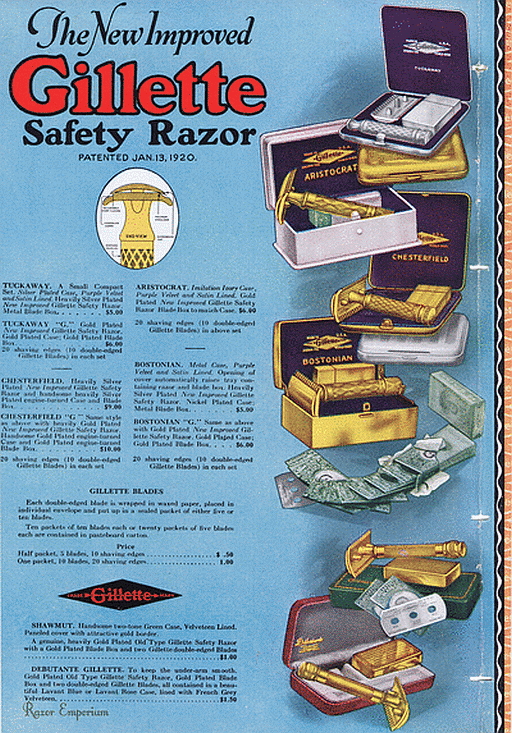
The 1920’s brought with it the first major change to the original “Old Type” razor design, dubbed “The New Improved.” Not only did this razor address some of the design and performance concerns of the first series of razors Gillette put out, but it also created the first complete “line-up” of razors available. No longer were owners presented with one choice of a Gillette razor, but now had the option of selecting between differently styled models such as “The Richwood”, “The Bostonian” and even “The Big Fellow.” And with each name came a different styled case and brand persona that was created. Some of these names went on to incarnate themselves throughout several more decades and razor lines, most notable “The Aristocrat.” As simple as this seemed, this model would continue throughout Gillette’s history: offering the same product in different styles to better capture customers with the gimmick of packaging and persona. Just another marketing strategy that later automobile, telephone and wrist-watch companies caught-onto.

1930’s: The Goodwill

Towards the end of the 1920’s the stock market crash affected the entire world over. And whilst still manufacturing razors, Gillette had to change their approach when entering the next decade. They even scrapped many luxurious and high-end models such as the “De Luxe Edition” in favor of budget razors for the first few years after the crash. In an effort to stay current with the nation’s climate, Gillette launched the NEW razor, in line with President Roosevelt’s social recovery plan the New Deal.

Again, these promised even further revisions and improvements to the razors that had just came out years earlier. The real secret behind the ongoing razor improvements was expiring patents and keeping third-party blade makers behind the curve as they started to encroach on Gillette’s bread-and-butter business model.  With this model of razor, notice that a new style of blade is again issued to be used in conjunction with the new shaver—a model that Gillette continues to use even today.

Advert images from Razor Archive.

The Marketing Powerhouse that was and still is the Gillette Safety Razor Company, part 2

Here is the second in this fascinating series of articles by Matt Pisarcik of Razor Emporium:

1910’s: Wartime Sales & Ladies Shaving

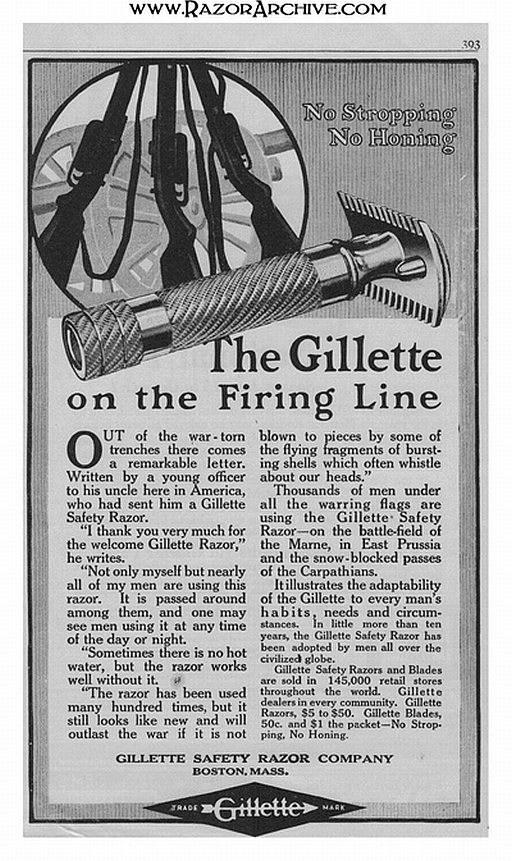
As the company moved forward with early success in the 1900’s, a new decade was upon them and with it came the need to keep current. With products being sold in 145,000 retail stores throughout the lands, Gillette was truly beginning to be “Known The World Over,” a slogan that they also incorporated into their Diamond & Arrow logo which appeared around the end of the previous decade. One great milestone of the ‘teens for the razor company was the contract with the United States Army to furnish razors for soldiers fighting overseas. Not only did the company capitalize from the contract itself, but also on the prominence of their shaving system being selected for war-time usage.

Advertisements like these were prevalent in newspapers, evening posts and journals, talking about the reliability and performance that soldiers trusted the Gillette razor to give. All the while, this endorsement marketing technique built the reputation and house-hold name of the Gillette Safety Razor Company. Models that never even went to battle were still marketed to the general buying public as if they had. And better still to the war-time production, soldiers returning from overseas came home to become life-long buyers of Gillette blades for their Uncle-Sam issued razors!

Another highlight of the teens was the capturing of an entire buying segment that up to this point remained seriously un-tapped: female shaving needs. Initially titled The Milady Décolleté, the original offering to women was a “safe and sanitary way to the smooth underarms demanded by both good grooming and good dressing.” In essence, Gillette capitalized off reaching a new segment of the shaving population by popularizing the practice in itself. In other words, they made women want to shave their arms, and also want to buy a Gillette to do the shaving. Simply brilliant. Later on, Gillette went a step further to convince European women to do the same thing, and even added in the popularity of clean-shaven female legs. What a concept!

Advert images from Razor Archive.

The Marketing Powerhouse that was and still is the Gillette Safety Razor Company, part 1

We are very lucky indeed that Matt Pisarcik of Razor Emporium, an expert on the subject, has agreed to write these articles that give us some fantastic background and context when looking at traditional shaving today and our continuing use of great classic razors:

Company Origins

When most people think of the Gillette Safety Razor Company, they most likely immediately picture their safety razors of yesteryear or perhaps the modern plastic shaving systems of today. And if you thought a bit harder, you may even conjure up an image of company founder King C. Gillette’s face plastered on all early safety razor blades, boxes, instructions and so forth; or your father using one of their razors to shave with. However, it would take a while before you may come to think of them as a very leading advertising agency, which is precisely what Gillette was throughout most of their history.

Around the turn of the century, safety razors were already in existence and gaining mild popularity. Companies like Kampfe Brothers (the inventor of the Safety Razor), GEM and even J.A. Henckles of Germany were popularizing the new trend to own a shaving razor. While these shaving devices merely put a miniaturized straight razor blade upon a handle, they certainly did start the ball rolling away from the traditional cut-throat style razor popular in barber shops.

This was the market climate that a middle-aged King Gillette found himself in—where even a safety razor blade still was a life-long tool that needed upkeep and care; requiring the owner to hone and strop the blade with regular usage. An idea was born for a disposable safety razor blade utilizing thin sheet-metal sharpened on both sides; made cheap enough to throw away but good enough for several acceptable and comfortable shaves. King had his patentable invention, and along with it, a customer who would need a life time supply of these blades with the onetime purchase of his fancy handle.

This set the stage for what we now know as “Freebie Marketing”, in which the customer receives what is perceived as the product for next to nothing in cost, yet has to upkeep or furnish this device with replacement parts that actually are the revenue-driving component of the business model. Other examples include computer printers and ink/toner, automobile parts and even gaming consoles and software.

1900’s

Another common method of marketing that Gillette used pervasively and came to perfect was Printed Advertisement. In these high-quality scans from Razor Archive, one can clearly see the early push that Gillette employed to get men to stop using straight razors or visiting barbershops all together. They constantly talked about the hassle of upkeep on a traditional straight razor, saving time and of course “No Honing, No Stropping” that they even incorporated into their logo. Gillette even ran attack ads against barbershops; spreading fear of infections and disease that can be spread by visiting one, and that all together they were dirty and unclean places.

Not only was there a product to be sold in these adverts, but more importantly a message and a promise from King himself—urging the public to try his razor for a 30 day trial or guaranteeing it will be more comfortable than other methods of shaving. Again, such common advertisement techniques that we know of today were not so common in an era where manufacturing companies rarely interfaced so directly with their target market of consumers and instead relied heavily on retail stores to drive sales.

to be continued……

The Gillette adjustable razors

So far on this blog when discussing vintage Gillette razors I have mentioned the basic Tech model. This simple but effective 3 piece design has a two piece head, clamping the blade, which is held together by screwing in the handle. I have also written a brief history of the more upmarket Super Speeds, which are a one piece razor with butterfly doors in the head operated by a Twist To Open (TTO) mechanism. But top of the heap of the three main Gillette models were the adjustables.

The adjustable razors have a clever mechanism that allows the user to adjust the blade exposure, or aggression, of the razor very quickly. On these Gillettes this consists of a moveable ring going round the handle just under the head (though a small number were built with it near the bottom of the handle) which is numbered 1-9 (though some rarer models were 1-5). Virtually all the Gillette adjustables were also TTO. So to change the aggression of your razor all you needed to do was to slacken off the TTO mechanism a little and then rotate the adjusting ring, which clicked into the position chosen, then tighten up the TTO again.

Users mostly tend to experiment with the adjuster till it gives the results they needed and then just leave it in this one setting. But there are other use strategies. Because traditional shaving salami slices the hair in consecutive passes you can start with the adjuster set fairly aggressively, to take off a big slice, then dial it down to take off smaller slices in subsequent passes as the blade cuts closer to the skin. Another strategy is to dial down for those areas which are prone to bleeding from weepers, such as under the chin. Or you can just make up your own strategy and do what suits you. This is part of the variety and fun of real, traditional, shaving.

In all there were probably 14 different Gillette adjustable models, but here we will concentrate just on the three main models and one less common model. Once again there is a caveat that this is a simple introduction, not an academic paper.

The first to market was the 195 model, so called because it retailed at $1.95. We know it as the Fat Boy because of the fat handle need to accommodate both the TTO and the adjustment mechanism. It was also a heavy razor with all the features it offered. The Fat Boy is a great razor to shave with even today, it was only made for 4 years 1958 to 1961, so is less common than some other models. These features  make it an extremely collectable razor, most traditional shaving enthusiasts either have one or want one. Currently in reasonable shaving condition they sell for about $35.

Gillette, like any successful company, sought to improve their products, so they managed to engineer the mechanisms to fit inside a narrower handle. This is the model we call the Slim and it was made from 1961 to 1968 and it is a little lighter than the Fat Boy. Fitting all that mechanism into a narrow handle wasn’t a total success, however, I have known two Slims to jam up their adjustment mechanism completely with the grime caused by shaving.

After the Slim came the Super Adjustable, this was a little lighter again, came with two different handle lengths and is easily identified by its the black aluminium handle. It was made from 1969 to 1986 so had a very long production run indeed, though there were design changes, such as the black plastic lower head plate which was introduced in 1977.

If you want an adjustable razor today you have to go to the German firm of Merkur and their three adjustable models, the Progress, the Futur and the Vision.

Now we come to the fourth, less common, Gillette adjustable, the Toggle. The toggle, quite simply, had a metal toggle at the bottom of the handle which worked as a lever to open the butterfly doors in the head (instead of having a TTO), this mechanism made them the heaviest of the adjustables. They were only made in very small quantities between 1957 and 1960 and they are extremely sought after by collectors. The supply coming to market is very small indeed, so if you want one expect to pay up to $400. Or you could get lucky and find one in a junk store for $5. This happens.

After reading all this you will probably want to see what they look like, so I can point you at two great websites. At Country Joe’s Collectable Stuff there is a section for identifying vintage safety razors, also his vintage razors for sale has lots of good photographs and gives you an idea of the market. Mr Razor in Germany has his History of the Gillette Safety Razor with some fantastic photographs covering most models (click on the thumbnails). He also has great resource of instructions for different razor models and he has an eBay store that is full of temptations.

As you can see, traditional shaving offers infinite variety and a huge range of fascinating, enjoyable experiences. Owning and using one of these vintage Gillette adjustables is a fantastic start to the day, you know you have done something special that is denied to most other people.

Gillette Super Speed advertisement

The above is a lovely advert for the three Gillette Super Speed models that existed in production alongside each other during the mid to late 1950s. I will now try and put this in context, but this isn’t some academic paper, it is just me, so don’t rely too much on the facts!

The basic Gillette model for many decades was the Tech, a three piece razor where the handle screws in to clamp the blade between the two pieces that make up the head. These are cheap and simple to make and the rigid construction has the potential of a good shave if it is engineered properly. Many manufacturers around the world still make copies of this three piece construction. The Lord razor I wrote about earlier is one such.

The problem with the Tech is that changing blades can be a bit fiddly, Gillette decided to make a more upmarket razor that overcame this. Thus, during World War two, the Super Speed appeared with limited production between 1942 and 1945. In 1946 full scale civilian production started and this original version of the Super Speed was available from 1947 to 1954.

The Super Speed’s defining feature was the butterfly doors of the shave head that allowed easy blade insertion, these were operated with a Twist To Open (TTO) mechanism via a knob at the base of the handle.

In 1954 the original Super Speed was replaced by the “Flare Tip” Super Speed which has a flared TTO knob. Then in 1955 Gillette introduced two variations on the basic model. The Blue Tip was lighter with an aluminium handle and it shaved less aggressively (so was favoured by women), it had a blue painted TTO knob. The Red Tip was  heavier than the standard Flare Tip and was more aggressive, obviously it had a red painted TTO knob.

It is these three models, the Flare Tip, Blue Tip and Red Tip that feature in the advertisement video above (for $1.29 each!). The Red and Blue tips had a short production life, just 1955 to 1959. This is because in 1958 Gillette introduced the Fat Boy adjustable razor, where the user could dial in the required degree of aggression, this made the two Super Speed variants obsolete.

The standard Flare Tip went on being made till 1966 when it was replaced with the black handled Super Speed, this remained in production till 1986. So the production life of the Super Speed razor was 1942 to 1986, that is 44 years.

The Super Speeds are classic razors, readily available secondhand and all of them still give a good shave today. Many traditional shaving enthusiasts own one or more of these. Gillette certainly got it right when a 65 year old mechanical device can still hold its own today.

And just as the Tech was widely copied, so was the Super Speed. The Weishi is a Chinese made near copy that is constructed all in aluminium, for instance. So the Super Speed lives on.

online poker
SuperSignupBonus