Entries Tagged 'Shaving soaps and creams' ↓
January 28th, 2011 — Shaving soaps and creams

After the disaster that was Durance hard shaving soap you would think that I would give up on experimenting for a while. But I need to generate content for these articles so it was a case of “once more unto the breach” and, as you will see, this is an experiment that was very well worthwhile.
The story started when I received this email:
Hi Bruce,
My wife and I run Alenka & Sam’s Shave Shack (shave-shack.com.au) in Australia and are looking for some exposure on selected products. Is it possible for you to do a review on some shaving products for us?
To start with I would like to send you some Otoko Organics, it’s unique composition is difficult to describe, but it is something different and very unique, it sells well after people have tried it. For example a friend who has tried lots of different products from our stock bought 5 tubs of Otoko and 5 brushes for Christmas Gifts he recommends it so highly!
Please let me know if you are available to do this for us
Thanks
Sam.

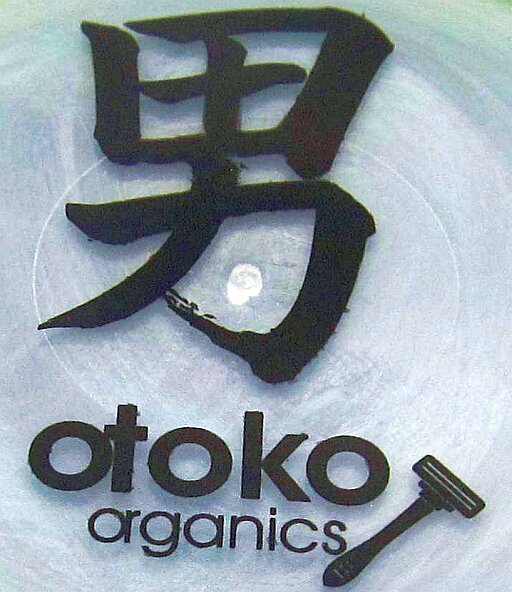
Obviously I said yes and the soap arrived very quickly from Australia. And Sam is right, it is different and unique. It is a translucent, dark blue shaving soap. It has small bubbles in it, as if it has been poured hot into the pot. Overall it looks like a piece of plastic or jelly. It smells very nice though.
No wonder it looks so different, when you look at the ingredients it looks like it comes from another planet compared to traditional shaving soaps. Here they are: Jojoba extract, Deionized water, Proprietary no-ionic surfactants derived from soy and corn, Aloe vera and Glycerine in what they call an organic colloidal formula. Very, very strange.

Otoko Organics shaving soap puck after two shaves
The marketing blurb on their website says:
Made from 100% organically grown natural coconut, palm, soy and jojoba oil with aloe vera and pear essence, Otoko Organics contain only cold pressed organically grown plant extracts and the highest quality plant essences. Otoko Organics Wet Shave Essentials provides a certified organic way to deeply clean and soften your skin while lifting and softening your hair follicles before shaving. A rich soft lather with no harsh chemicals helps resist skin irritations and shaving burn. Vitamin E and aloe vera soothe and protect your skin. Anti-allergens and perfume free to safe guard from allergic reactions. Naturally occurring astringents penetrate pores to remove excess sebum, oils, skin impurities and dead skin cells. Our naturally rich foaming formula removes air pockets allow the razor to glide smoothly across the skin, resisting cuts and skin rash. Foam levels can be individually tailored to suit your skin type.

So what is it like to use? Well it is different, and in a good way. For the first shave I used my favourite brush, the Morris & Forndran Blonde Badger. When I applied the wet brush to the hard soap I didn’t think that it was picking up much product, however when applied to the face it very quickly made a Father Christmas lather. It did this for all three passes and afterwards there was enough left to paint much of my body (in the shower!), so this is a pretty concentrated soap.
The lather doesn’t feel lush in a TOBS Avocado kind of way, but it is a magnificent lubricator. Pretty soon I was confident enough to buff against the grain with a Slant Sledgehammer / Feather combination, something you would not try unless the lather was working very well. This confidence enabled me to get a very good and very close shave with little effort.
Going into this shave my facial skin was still a little traumatised after the previous two days’ use of the Durance soap, the Otoko has not aggravated this and, if anything has calmed things down. It looks like all those soothing ingredients have worked.

Day 2. With my face recovered from the trauma of using Durance it was time to pick a brush to use with the Otoko. I went for the small Simpson’s Beaufort B1 in pure badger. A fine hard soap brush and a fine face lathering brush, I thought this would be a good match with the soap, and so it proved. This time less soap was loaded on to the brush and it still made three passes. The sensation of using the soap is a little strange because it doesn’t have that lushness yet lubricates exceptionally well. This time I buffed quite extensively against the grain in the first pass with the Slant Sledgehammer / Feather combination with no problems at all. With practice you could do an acceptable one pass shave with this soap.

So I like it and will use it a lot more. It is very different from any other soap or cream I have ever shaved with, yet it does an exceptional job. The natural soothing ingredients are just an added bonus.
Otoko Organics costs 18.95 Australian dollars for a 70g pot. This is about £12 in British money. The American dollar and Australian dollar are level pegging so it is about $19 American.
January 26th, 2011 — Shaving soaps and creams

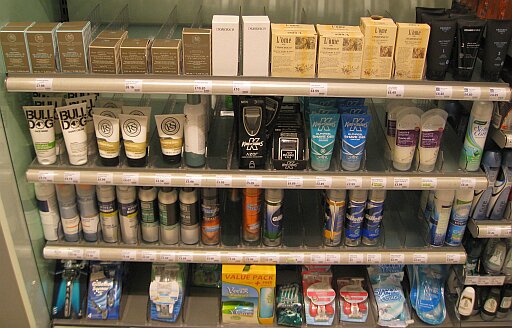
Waitrose shaving department
Here on the interwebs there are very many reviews of shaving products by consumers, in fact some websites actively encourage this by having dedicated areas for such content. You would think that these would be really useful, but experience has taught me that they are often pretty useless as a source of information. The first problem is that many reviewers are glowing in the ownership of some shiny new kit, so all you read is this glow. The second problem is that many of the reviewers are writing about their only razor or only brush, they lack the subjective and objective knowledge to write anything meaningful that bears any context. It doesn’t stop them though.
Against this background came a trip to the upmarket British supermarket Waitrose, where there was a variety of stuff on display including Durance L’ome Bol & Savon A Barbe A l’extrait d’Argousier. This has received some very mixed reviews and as it was only £5 it was worth the risk to find out. The product is beautifully presented in a brown cardboard box containing the white ceramic bowl within which is the very white hard soap.
On the box it says “This traditional shaving soap was created to make shaving easier thanks to a fine and unctuous foam. It protects epidermis and prepares it to shaving.” The main listed ingredients are Potassium Palmate, Sodium Palmate, Potassium Stearate, Potassium Palm Kernelate, Sodium Stearate, Sodium Palm Kernelate and Glycerine. Which seems a lot of potassium fatty acids to me.

To give it the best possible chance and having experienced other hard soaps that can sometimes be temperamental a few drops of water were put on the puck a few minutes before starting to shave. Then to further help it perform well the Turkish horse hair brush was selected. In the shower the brush loaded nicely with lots of product which then worked up into a fine Father Christmas lather on my face. I then turned to put the brush on the rack and when I turned back the lather had gone! Just totally collapsed. After struggling through the first pass it was time to massively load the brush with more soap only to get the same result. And again for the third pass. Not good.
Day 2 it was time to get extreme and the puck was left to soak in the sink for five minutes or so before being put into its nice bowl, which was then filled up with water, to be drained just before use. The brush this time was the Semogue Owner’s Club, another brush that should make any hard soap perform well. Once again, for the first pass, the brush was heavily loaded and created a fine Father Christmas that promptly collapsed. Time for drastic measures. For the second and third passes the slimy puck was directly rubbed on my face till it was white with the soap, this was then made into a very thick creamy lather with the brush, which again promptly collapsed as far as it could.

All this wouldn’t matter if it lubricated the shave. But it didn’t. My superb razors felt decidedly average and afterwards I felt like I have sensitive skin, which I don’t. And the shave wasn’t very good either.
Overall this product is like some artisan soap makers create, just add bentic clay to an ordinary soap and call it a shaving soap, even though the lather collapses. The Durance is like this but without the bentic clay to give it lubrication. In my opinion it is easily the worst shaving soap or cream that I have ever used, totally unsuited for the job of shaving, it will now be used for washing my hands, let’s hope it can at least do that. All IMHO and YMMV of course.
What makes this very sad is that there is a brilliant French shaving soap, Monsavon Bol A Raser, that Waitrose could and should sell in Britain as it is totally unavailable here. And it is a lot cheaper than the Durance.
And I had a narrow escape, Waitrose also were selling a Durance badger shaving brush for £10. If the shaving soap is anything to go by I could have wasted three times as much money.
January 17th, 2011 — Shaving soaps and creams
January 11th, 2011 — Shaving soaps and creams

Today we have another guest writer, it is Krissy Yoder of the artisan soap maker Prairie Creations, who has written this fantastic article about some of the chemicals that go into our soaps, creams and balms. It follows on from an article I wrote here earlier “Chemicals you don’t want in your shaving soap or cream” but obviously Krissy is far more expert on the subject than I will ever be:

The use of preservatives has always been a hot topic among many different groups of users. There are many people on each side and everyone has their own opinion on them. The media has taken a story and someone ran with it and twisted the truth. I have yet to read anything that proves beyond a shadow of a doubt to prove that parabens in products cause cancer. Even the cancer society doesn’t say that it causes cancer saying there isn’t enough evidence. So I will quote: http://www.cancer.org/Cancer/CancerCauses/OtherCarcinogens/AtHome/antiperspirants-and-breast-cancer-risk
“There are no strong epidemiologic studies in the medical literature that link breast cancer risk and antiperspirant use, and very little scientific evidence to support this claim.
In fact, a carefully designed epidemiologic study of this issue published in 2002 compared 813 women with breast cancer and 793 women without the disease. The researchers found no link between breast cancer risk and antiperspirant use, deodorant use, or underarm shaving.”
Preservatives are necessary in cosmetics just like in food to keep them from spoiling. To prevent the growth of mould, yeast and bacteria. Anything that contains water or will have water introduced into the container needs a preservative. This is extremely important for your safety. That means, lotions, creams, sugar/salt skin exfoliating scrubs, aftershave balms, aftershave milk, and even some shaving creams. All these items need to be properly preserved.
There are several types of preservatives on the market for use.
Most commercial companies used multiple preservatives so their product will almost have a shelf life of next to forever. Most of the preservatives that they use are paraben preservatives. Not that paraben preservatives are bad, because we use them often in many commercial products that we use day to day. Shampoo, Conditioner, Laundry Soap, Dish Soap along with all the other household cleaning products that contain water. Glass cleaner, surface cleaner and any other cleaner used.
Then you have those that make cosmetics and they have choices on the preservative that they want to use. There are several choices and some are paraben based while others are not. Not all of these preservatives are created equal. They have different usage rates and they have different ways they are used. They are added at different times during the process and others have different requirements as far as oil percents or are pH sensitive.
Here are a few common examples:
Germaben II : (Propylene Glycol (and) Diazolidinyl Urea (and) Methylparaben (and) Propylparaben ) This is a paraben preservative and requires less than 25% oil in the product that it is put in. This preservative needs to be added to the water in the formula prior to being emulsified with a temperature of 140` or lower.
Germaben II E (Propylene Glycol, Diazolidinyl Urea, Methylparaben, Propylparaben ) This is a paraben preserviate and requires more than 25% oils in the product that it is put in. This preservative needs to be added to the oils prior to being emulsified with a temperature of 140` or lower.
Liquid Germall Plus (Propylene Glycol (and) Diazolidinyl Urea (and) Iodopropynyl Butylcarbamate) it also comes in powdered form which does not contain the propylene glycol. This is one of the most common preservatives with good reason. It has a good history of being effective and is one of the most universal preservatives. It does not have an oil requirement and can be used in almost anything expect products that are put into contains that will mist the product into the air. It does have a temperature requirement that the product needs to be 122` of less so it’s added at the end. It’s also paraben free for those that are concerned about that.
Phenonip (Phenoxyethanol (and) Methylparaben (and) Ethylparaben (and) Butylparaben (and) Propylparaben (and) Isobutylparaben ) is another popular preservative but it contains parabens. It can be used in both products such as oil based scrubs or lotions but it must be added to the oils before being mixed with water. It is also pH sensitive with a pH between 3 and 8 so you need to check that to make sure it will be effective.
Optiphen Plus (Phenoxyethanol (and) Caprylyl Glycol (and) Sorbic Acid ) is another popular choice by many. It has been noted that it preforms best when used in products with a pH that is below 6 but has also been proven with a higher pH as well. One thing you won’t hear often about this preservative is that it does have a short shelf life. So it might be expired or close to being expired when it’s delivered from the supplier. So make sure the supplier orders it in small amounts themselves to ensure they are sending out a fresh product. One other issue with this product that has been noted by several users including a supplier is that mould can form on the top of the product if condensation forms inside the jar. This would be a concern for me because many people might get natural condensation forming inside the jar after it’s delivered just because of the conditions that it is stored/used in.
There are many people who believe that natural preservatives are better. I have never seen a lab report to prove that these are better. While I have seen lab reports to prove the chemical preservatives are effective and do what they say they will do. I do believe that if there was a natural preservative available to crafters that was proven to be effective than no one would be using a chemical one.
Potassium Sorbate is a commonly used one. This is not a cosmetic preservative but has been approved by the FDA as a food preservative. They are not interchangeable. There are many suppliers that do sell potassium sorbate as a preservative but they clearly state that it is not meant to be used alone as a preservative and needs to be used together with a chemical one. It is also very pH sensitive so proper equipment needs to be used to check the pH. (litmus paper isn’t accurate enough for testing for this) I shall quote lotioncrafter a popular supplier “While it shows some activity up to pH 6 (about 6%), it is most active at pH 4.4 (70%). At pH 5.0 it is 37% active. As sorbic acid, it is considered to be active against mould, fair against yeast and poor against most bacteria.” While potassium sorbate does occur naturally in nature the potassium sorbate that is purchased can not be considered natural because it’s manufactured synthetically from gas ketene.
I’ve even seen my share of sellers claim they are using citric acid as a natural preservative. This is very scary because it’s not an effective preservative it will only adjust the pH but it won’t prevent mould, bacteria or yeast from growing.
Another product commonly called a preservative is Grapefruit Seed Extract (GSE). Like the Potassium Sorbate it simply is not effective enough on it’s own. The quality of the product itself makes a difference and most what is sold simply isn’t strong enough to be effective.
Others claim they are preserving their products naturally by essential oils. Like the others they might have some properties to be effective but the reality is for them to be effective they would need to be used at levels that are unsafe. This includes the grapefruit seed extract.
There are a lot of people who get confused when it comes to antioxidants and preservatives. An antioxidant is used to keep the oils from going rancid sooner to give the product a longer shelf life. They do not prevent mould, bacteria or yeast from growing in the product. It’s important to know the difference.
Rosemary Oleoresin (ROE) is a common antioxidant but it does have a strong herbal scent but only a small amount needs to be used.
There are two types of vitamin E. They are much stronger than what is purchased in local stores down the vitamin isle. Many people buy the capsules and open them, and they are not as effective as either of these. Vitamin E Acetate (tocopheryl Acetate) this has been used a long time in the cosmetic industry but it is the synthetic version and is lab made. The natural version is darker in color and is called just Tocopherol. This is more expensive but it is natural and you use less.
I hope this explains preservatives a little more and why it is necessary to use the correct one for the product being made.
Krissy Yoder
Prairie Creations

December 9th, 2010 — Blades, Razors, Shaving brushes, Shaving soaps and creams
Firstly a disclaimer, the variety of traditional shaving kit on sale is so vast that the choices are effectively infinite. And because you are different to the next man so what kit is best for you will be different, this is part of the joy of shaving this way, you can customise to your own exact personal likes and requirements. So what follows is just one man’s opinion, yours may differ substantially. Also because I am UK based this is reflected in some of the choices, however the interwebs have made us one big global community so this is not the problem it once was.
Soaps and creams.

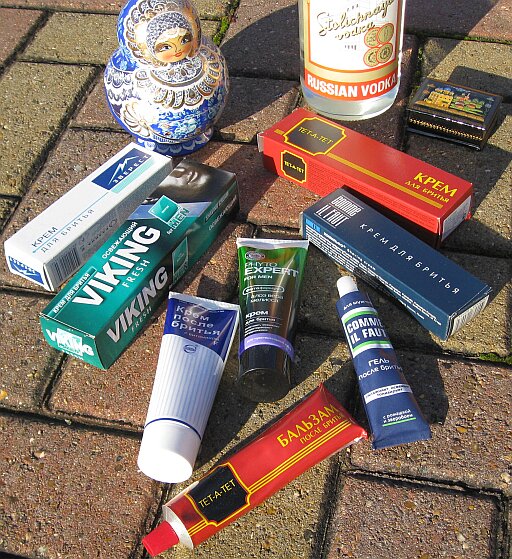
Russian shaving creams and balms. Svoboda, Tet A Tet, Comme Il Faut, Viking, Everest, Phyto Expert
Basically creams are just soaps with water added to make them easier to use. So hard soaps are much more concentrated and can work out far cheaper per shave even if they cost more.
One of the very best soaps in the world is the Palmolive shaving stick that you can often get for under £1 in English supermarkets. Just rub it into your stubble like a big crayon then whip up into a fantastic lather with a shaving brush. The brush will then have enough charge left in it for second and third passes. This is not available in America so American traditional shavers buy it at a far higher price on eBay or bring home masses of sticks when they come here on holiday. I have done some great transatlantic equipment swaps for these sticks.
An excellent low cost cream is Ingrams which you can buy in many chemists and supermarkets. Loaded with menthol this is superb in the summer. Once again impressive value for money.
Going a bit upmarket there is Mitchell’s Wool Fat (MWF) shaving soap. This stuff is a legend and is really good for your skin. Keep it in a sealed container between shaves. Mantic59 has just done a YouTube video on how to get the best out of it. It is actually very cheap to use as a puck lasts a very long time indeed, buy online. Also it prefers a brush with a bit of backbone, like a Vulfix 404 boar/badger mix.
If you are a cream person then the step up from Ingrams is probably Body Shop Maca Root which is truly lush and is available on any high street. Sometimes they have it on offer which is a good time to stock up.
Then there are the St James’s soaps and creams from the male grooming shops in London (and online). The best value creams here are Taylors of Old Bond Street (TOBS) who have a range of different flavours. It is good to visit their Jermyn Street shop and smell them all to see what you like. About £6 for a tub.
My favourite hard soap is Trumper’s Violet. This is expensive but lasts a long time. It lathers up much more easily than MWF and the violet is very soothing.
If you want 100% natural stuff then there are artisan shaving soap makers. The best respected in England is Nanny’s Silly Soap Company (online). Beware some artisan soap makers just add bentic clay to an ordinary soap to make their shaving soaps and the results are frankly rubbish.
Beyond the above there are thousands of different creams and soaps available around the world. The Russian creams, especially Svoboda, are excellent as are the Indian creams, most famously Godrej menthol mist, which is a bit special. The Italian soaps and creams from companies like Proraso and Cella have excellent reputations and I like them a lot.
Shaving brushes.

These are the most expensive part of traditional shaving. A top brush from a top manufacturer will be about £80 and upwards, but will last at least 30 years as your only brush. If you have several brushes it will last for ever. However there are far cheaper options as we will discover. Some people have large collections of brushes.
The brush has two components, the handle and the knot. With handles wood will not last as long as plastic, no matter how it is treated.The knot has very many variables which effect the way it works. One very obvious characteristic is the variation from floppiness to backbone.
Diameter at the base. This is the knot size. Too big eats cream/soap too small is more work to use.
Loft is the height of the bristles from the handle. They also go some way into the handle.
Knot shape. Flat top, bulb and fan are the main shapes. Most are a combination some way between these.
Hair variety. Badger, boar, horse and synthetic. Each behaves differently, each has followers.
Hair grade. Each of the above varieties is available in many grades and you tend to get what you pay for.
Knot density, how tightly packed the hairs are.
And you thought it was going to be simple!
Boar brushes tend to have more backbone which makes them work well with soaps. A good boar brush doesn’t have trimmed ends to its bristles and so with use they split and the brush becomes softer. This “running in” process can take several weeks and reveals the full performance of the brush. An excellent cheap boar brush is the Jaguar from Turkey, bought online for £5ish. The detail finish is not brilliant, but the brush is. After that the main brands of quality pure boar brushes are Semogue in Portugal and Omega in Italy. These are great brushes and you get what you pay for in the range. They are an online purchase. I have both. Allow £20 for a good model.
There is also the Vulfix 404 boar/badger mix brush which is just a beautiful and brilliant all round brush and is something of a bargain at less than £10 from these people.
Badger brushes tend to be softer and more expensive. Nearly all the hair for them comes from China, where badgers are vermin. The Chinese graduated to making whole knots and then whole brushes.
The bargain is to buy a Frank Shaving Finest Badger (not the silvertip) for about £10 from Ian Tang in China on eBay. He has good customer service and the brushes take about 10 days to arrive, they look beautiful and are well presented. There are a range of knot sizes, shapes and lofts. I bought three of these brushes then Ian sent me two to review for my blog. The value and quality is such that they have taken the traditional shaving world by storm and with lots of positive feedback.
You can buy brushes with the retailers name on them, Trumpers, Taylors of Old Bond Street etc. Don’t. You don’t know who the manufacturer is. Better to buy one with the makers name on it. The two great, famous, British brands are Rooney and Simpsons.
Rooney are in London and make very small quantities of fantastic hand crafted brushes.
Simpsons are owned by Vulfix on the Isle of Man and make somewhat larger quantities of equally fantastic brushes across a huge range, from £20 to several hundred pounds. Models like the Persian Jar, Polo, Chubby, Milk Churn and Wee Scot are classics. I have just two Simpson’s brushes. Buy them at good prices here.
If you want to spend lots of money then Plisson in France (which Napoleon used) make exquisite bulb shaped brushes from European badger for several hundred pounds.
Horse used to be the most used brush hair before anthrax scares moved people onto boar bristle. They are fantastic brushes and have the benefit that no animals are harmed in making them, the hairs come from natural grooming.
This Turkish brush for just $2.45 is simply amazing. The biggest bargain in shaving. The detail finish is not perfect but the brush really performs.
Next up are Vie Long from Spain which you can buy here. About 10 Euros will get you an excellent “Barber Brush” (which I have), a few Euros more and you are into their very nice branded range.
Synthetic brushes are useful in that they dry out instantly so are good for travelling. There are two sorts.
Firstly there are the simple nylon strand brushes. The £5.50 Body Shop model is a perfect example.
Then there is “synthetic badger”. The theory is that these all come from Omega in Italy, no matter what brand names is on them. They are £30+ and they are excellent.
For a bit of further reading there is Fido’s shaving brush blog which you can find in the blogroll on the right here.
Razors.

Different razors perform and handle completely differently to each other, like different cars. And there are adjustable razors that are a bit like having a gearbox, you can alter the thickness of each slice of hair that they take, but the fundamental characteristics of that razor don’t change.
As ever I can’t over-emphasise that the choice is personal. What you use and how you use it is entirely up to you, the options are infinite. This is the exact opposite of what the big global shaving companies try and impose on you with their patent protected multibladed system razors.
There are two main routes you can go down, vintage razor or current production razor, let’s deal with them separately.
Vintage razors.
These are rocketing in value. But ask round friends and family and see what turns up.
With over 100 years of production there are a lot of different models to choose from but most are made by Gillette.
The Tech is a simple three part razor. Handle and two part head that just screw together. Often found in travel kits. Gives a very good and mild shave. Plentiful and cheap, everyone should have one.
The Super Speed is a succession of models with twist to open butterfly doors. These are the backbone of the traditional shaving revival. Mild shavers except for the model with a red tip to its handle which is a medium shaver.
The adjustables. Fat boy, Slim and Super Adjustable. Just dial in the aggression you want. Between passes or mid pass. Less common and going up in value fast.
There are plenty more but these are the main ones. Avoid old razors with toothed heads, except to collect till later.
Current production.
Start with a Weishi off eBay or a Wilkinson Sword Classic in black delrin from Boots for less than £5. These are very mild and won’t bite. Even when you are up the learning curve they are still good for a buffing and polishing third pass. There are also the Lord razors from Egypt which are less mild and which are exceptional value. Then there are the Edwin Jagger razors that have taken over from the Merkur 34C to become the “standard” traditional razor. The new Edwin Jagger head, which they seemingly co-developed with Muhle in Germany, is amazing. It feels bullet proof, as if it will never bite, yet it very effectively and effortlessly slices through the stubble. It is easy enough for beginners yet rewards the more experienced. And the razor is beautifully made, a real piece of craftsmanship and engineering for about £20.
If you want to spend more get an iKon, handmade in Thailand, buy the tooth headed model. More money still and you want the Mergress conversion of the Merkur Progress adjustable. Made in small batches you go on a waiting list, they sell out in one hour once released. Finally there is the Feather Stainless Steel from Japan which is yet more expensive.
When you get expert you might want to try a Merkur Slant Bar, probably the most powerful shaving tool known to man. So efficient that they are perfect for people with very strong beard growth and sensitive skin.
There are plenty of others like the Joris and the Goodfella but the above list is IMHO a good guide.
Blades.


These are critical, because they do the cutting and there is a lot of difference between the different brands.
The three characteristics to look for are sharpness, smoothness and blade life. Like everything else to do with traditional shaving the experience is personal and varies from person to person. Some make a Feather blade last one shave, some make it last nine. Also different blades behave differently in different models of razor. The sharper the blade the better, then it can cut your stubble with the least trauma to your face.
Supermarket blades tend to be Personna, from Israel and Wilkinson Sword, from Germany. These are perfectly good blades and cannot really be faulted. However DE blades are so cheap that it is normal to buy them in 100s off eBay or from specialist retailers like Connaught, who also do sampler packs which are a really good idea as they allow you to try different blades to find out what works for you.
Probably the best razor blades that you can buy are the dozen or so brands that come out of Petersburg Products International (PPI) in Russia, that is 65% owned by Gillette. These include Astra, Sputnik, Permasharp, Polsilver, Rotbart, Nacet, Minora and the several different variations of the Gillette brand. They have just discontinued making Iridiums which were pretty legendary in the shaving community.
Gillette also makes DE blades in Vietnam, India and Brazil. These have excellent reputations but not as good as PPI.
Feather and Kai blades from Japan are immensely sharp but less smooth than PPI blades. Also they are very expensive. A Feather blade in a slant bar razor is supposed to be the absolute ultimate way to shave!
Lord in Alexandria, Egypt make several billion good quality blades a year under several brand names. Shark is the one with the best reputation. Though they are probably all the same!
Derby from Turkey are smooth and regarded as a good beginners blade, as are Personna from Israel. But you would probably be better off with a PPI blade.
If you want the best value for money then get Super-Max from Vidyut Metallics Limited in India, the world’s second biggest blade manufacturer. These are good and can be picked up at half the price of PPI blades.
One to avoid IMHO is Merkur blades from Germany, which are not as good as their razors.
Finally there is the shavepocalypse. The time when because of reducing demand the DE production lines are closed down. This has become more likely with the launch of the very low cost Gillette Guard system razor for developing countries which is targeted at DE users. This is why many traditional shavers have a stash of thousands of blades. They don’t cost much and take little space. Also they shoot up in value when a brand is discontinued as we have seen with Personna 74s, Gillette “Swedes” and now with Iridiums.
This article gives you a good place to start, but the choice out there is close to infinite, which is part of the joy of traditional shaving. So experiment, try different things and use what works best for you, even if it doesn’t work for anyone else!
December 2nd, 2010 — Shaving soaps and creams

Some of the biggest names in traditional shaving manufacture nothing, they are merely retailers, they put their brand name on a range of products made by other people. And the most prolific suppliers to these brands are Progress Vulfix, the brush maker, on the Isle of Man and Creightons of Peterborough in England who make some of the best and most expensive shaving creams.

Whether you are shopping in St James’s in London, at an upmarket American grooming supplier or from a famous global brand the chances are very high that what you buy is made by Creightons. But there is a way to buy Creightons products without paying a premium for a fancy brand, because Creightons have three of their own brands. Bottom of the heap is The Real Shaving Co with straightforward products that can be bought at low prices from discount retailers. Next comes The Natural Grooming Co brand in disconcertingly similar packaging, this is much the same but without the parabens and with “more organic ingredients”. The top brand is St James of London, which alludes to where many of Creightons’ customers have their shops, these premium products are available at upmarket retailers like Waitrose or by mail order directly from Creightons.
Creightons marketing people very kindly sent me a box of The Real Shaving Co goodies to sample (I already had bought and use some of them) so it only seems fair that I tell you about my experiences.

Professional Formula Daily Facial Scrub. For years the girls have been exfoliating with body and face scrubs. Basically these are creams with something mildly abrasive added. Something like apricot seeds. Rub it in and it removes some of the dead skin cells, which is, seemingly, a good thing. Previous generations (like the Romans) used pumice stones for the same purpose but these would be a bit rough on the face. And now as part of the explosion in male grooming we have face scrubs for men. I find that using one of these before shaving has a significant and profound effect. The shave becomes a whole lot easier, everything just works better. And the end result is a closer and smoother shave. I don’t do this every day but do it when I want to look especially well groomed.
The Real Shaving Company version of such a scrub does the job just right, it is easy to use and is not too aggressive, it is only very lightly perfumed and just does the job.
Pre-Shave Self Heating Face Mask. This stuff is intriguing, on the pack it says “hot towel style treatment to soften beard & prepare skin for shaving.” The instructions say massage in a liberal amount and leave for 5 minutes. When you apply it to your skin there is a brief burst of warmth that is not too hot and the cream contains exfoliant granules so the massage works the same as a face scrub. There is a fair bit of glycerine and tea tree in the formula so it is going to be kind to your face.
When I tried it the mask worked exactly as advertised and it came off quite easily in the shower (which is where I usually shave), but obviously it adds more time and procedure to the whole shaving process. Online this is what we English call a Marmite product, you either love it or hate it. I think I come into the former camp and will keep this as a weekend treat.

Professional Formula Shave Cream double concentrated. Absolutely excellent stuff and with advertising law being what it is how do they get twice the effect of normal creams? I am no industrial chemist but it looks like they took two routes. Firstly most soaps are sodium salts of fatty acids. It looks like Creightons used neat Stearic acid and Myristic acid instead of the tallow and palm oil that they usually come from, in other words more concentrated ingredients. Secondly shaving creams are basically soaps that are softened with water to make them easier to use. It looks like Creightons used a whole lot more potassium salts than sodium salts here. These potassium salts are much softer so less water is necessary, thus increasing the concentration.
Post Shave Soothing Balm. This has Glycerin, Lanolin, Aloe and Tea Tree in it, so lots of good stuff. It absorbs quickly and leaves your face smooth with no shinyness. A very good alternative to the Nivea, which is what many would buy at this price point.
Conclusion. Good to very good products at very reasonable prices indeed (if you shop round). They are very lightly and inoffensively perfumed and the plastic tubes they come in are very convenient for travelling.

Paraben watch. There is none in the shaving cream. All the other three have parabens in them. These can be avoided by buying The Natural Grooming Co products from the same manufacturer, except for the Self Heating Face Mask, which is only available in this brand.
Disclaimer. I did not pay for these products.
November 26th, 2010 — Shaving soaps and creams
November 24th, 2010 — Shaving soaps and creams

Nanny's Silly Soap Company
In an earlier article on here you were warned about some of the potentially nasty chemicals that can be in shaving soaps and creams, this was further reinforced when we looked at the contents of some Schick (Wilkinson Sword) Hydro products.
One excellent way to avoid this is to buy artisan shaving soaps and creams crafted in small batches from the finest natural ingredients. Probably the leading producer of such soaps and creams in the UK (but who ships worldwide) is Nanny’s Silly Soap Company, who developed their products in close consultation with the traditional shaving community.
Let’s see what they say themselves:
Nanny’s Silly Soap Company is a small artisan business which specialises in soap made without harsh synthetic ingredients. My soap is made with a range of luxury oils and exotic butters, carefully selected and balanced to produce a hard long lasting bar with creamy luxurious lather, gentle cleansing and scents from nature. No synthetic foaming agents, preservatives, chelators, scents or colours are used in my soap. Only essential oils and other botanicals are used for scent, and for colours plant based ingredients and clays are used.
All of the above applies to my shaving soaps, except that they are not hard – somewhere between a hard soap and a cream. They work well whatever type of brush you use.
Many people with dry itchy skin conditions, including eczema, find that natural soap like mine can improve their skin’s condition.
I have bought soaps and creams from Nanny’s Silly Soap Company and they are both excellent and very reasonably priced, so they can be thoroughly recommended. And now they have an excellent and highly professional new website that is much easier to use and which is a far better shop front for their products. Well worth a visit.
November 12th, 2010 — Shaving soaps and creams

Russian shaving creams and balms. Svoboda, Tet A Tet, Comme Il Faut, Viking, Everest, Phyto Expert
I am lucky in that my wife doesn’t just tolerate my male hobbies, she takes an active interest and contributes. We watch F1 races and football matches together, at the pub she will take a small sip of the different real ales so as to understand their allure and she loves blatting around the Warwickshire lanes in the Caterham. So it is with shaving, as presents she has bought me many St James’s soaps and creams over the years, also a fine Trumper’s shaving brush and, earlier this year, my Mergress razor.
Which brings us to Russia, a huge nation of 142 million people where most of the men are traditional wet shavers. So there is a big market for shaving consumables, and it is a market where shaving creams are favoured over shaving soaps. In the modern, capitalist, Russia free market competition dominates so there is plenty of competition to give this large customer base the creams they want, this has led to a proliferation of high quality products.

Russian shaving creams. Everest, Viking, Phyto Expert, Comme Il Faut, Tet A Tet.
Unfortunately these excellent creams (and after shave balms) are pretty much unavailable in the West. Perhaps because it is not worth the logistics for such low cost specialist items, perhaps because of the barrier that Cyrillic script presents, or perhaps because the manufacturers cannot be bothered. However there is a part of the world that was a part of the Soviet Union and that is now in the West and that is the Baltic states of Estonia, Latvia and Lithuania. These small countries are now in the European Union and NATO yet they have sizeable ethnic Russian minorities who like to buy Russian goods. So, uniquely, in these countries the West and Russia coexist culturally. In the language, in the food and in what you can buy in the shops.
You can see where this is going. Yes my wife goes to Latvia several times a year. And yes she brings me back the shaving creams and aftershave balms. And yes, they are excellent.
You never know, by publicising this it could increase the demand and/or the supply of these creams to Western traditional shavers, which would be a good thing as you can’t get too much choice.

Russian after shave balms. Svoboda, Tet A Tet, Comme Il Faut
October 3rd, 2010 — Shaving soaps and creams

Shaving soaps and creams are made up of lots of different ingredients. In a natural, artisan soap, like Nanny’s Silly Soap Company make you can be sure that all these ingredients are good, but in something like an aerosol foam or gel you need to be a lot more careful. Obviously our governments ban the worst culprit chemicals, but our knowledge is expanding rapidly and what was OK five years ago might have severe question marks over it today.
We are lucky that manufacturers are required by law to tell us what they are putting in our shaving soaps and creams. Some of them put it in 1 point type to make life difficult for us, other use, say, dark green ink on a dark blue background. So sometimes you need a magnifier and a choice of lights to actually read what they are telling you. Once you have that information you can go to sites like Scorecard and Our Stolen Future to find the truth about what threats they pose. You can also look them up on Wikipedia and in the European Union’s REACH programme.
Here are some things you may want to avoid:
Triclosan. An anti bacterial and fungicide that is used as a preservative. It is suspected of causing skin or sense organ toxicity and immunotoxicity. It is restricted for use in cosmetics in Canada and Japan.It’s safety is currently under review by the FDA
Benzophenone. This is an Ultraviolet blocker used to protect colours and scents. It is suspected of causing endocrine-disrupting effects and causing skin or sense organ toxicity. According to the European Union’s REACH program it is a Substance of Very High Concern and should be replaced by safer alternatives.
Ethylenediamine. A solvent that is suspected of causing respiratory toxicity, immunotoxicity, neurotoxicity, skin or sense organ toxicity and asthma. It is banned for use in cosmetics in Canada.
FD&C Violet 1 (C39H40N3NaO6S2) This colouring has a very long chemical name. It is authoritatively recognized to cause cancer, according to the State of California.
Boric acid. An anti bacterial and anti fungal preservative. It is suspected of causing reproductive toxicity and has been banned for use in cosmetics in Japan and restricted in Canada and the European Union.
Benzyl alcohol. Yet another preservative it is authoritatively classified as known to be neurotoxic in man is suspected of causing immunotoxicity and skin or sense organ toxicity.
Coconut Diethanolamide. A detergent, wetting agent and emulsifier that is suspected of causing cancer, immunotoxicity and skin or sense organ toxicity.
Triethanolamine (TEA). A surfactant and emulsifier which is suspected of causing immunotoxicity, respiratory toxicity, skin or sense organ toxicity and asthma. TEA may cause an increased incidence of tumour growth in the liver in some female mice.
Parabens. Ethylparaben, Methyl Paraben, Butyl Paraben, Isobutylparaben etc. Very widely used preservatives. There is concern that chronic exposure to paraben compounds with estrogenic activity may contribute to breast cancer. Studies indicate that methylparaben applied on the skin may react with UVB leading to increased skin ageing and DNA damage.
Retinyl palmitate (also known as retinol palmitate). An anti-oxidant has been shown to accelerate cancer in lab animals.
Don’t get paranoid, there are plenty of other things that cause us harm in our lives. But it might be worth taking a bit more notice of what you are putting on your skin.