Uses for blades. When King Camp Gillette invented the thin double edged razor blade at the beginning of the 20th century he intended it for face shaving. However a very sharp blade of consistent size cheaply and readily available led to it finding all sorts of uses. In trades and crafts, in hobbies, in the household, in science and in medicine. In fact in some countries now the non face shaving use of DE blades may be more than their original purpose.
Adjustable razors. These have a mechanism to quickly alter blade exposure, wasted on most users who leave theirs on one setting. Most Gillette adjustables range from 1 to 9, my Mergress goes from 1 to 5, then there is a plus sign. But the range the Mergress adjusts through is far larger than that of the Gillettes. When you get to the plus sign the blade is mightily exposed.
Your Mileage May Vary (YMMV). How often do we hear this about traditional shaving, especially when it comes to razor blades? One forum poster will say that a given blade is here to save the planet whilst the next will say that the very same blade eats small children. This is so common that it is something the community tolerates and understands.
Now to the story. Whilst being deprived of a supply of Iridiums I have been forced to try lesser blades, with mixed results. Meanwhile when I travel or am skipping the shower I often use an adjustable razor to emulate the three razors of the three razor shave, it isn’t as effective as using three separate razors as there is more to how a razor works than blade exposure, but it is a reasonable substitute. So I pop a blade into the Mergress and whizz it round to “plus” for the first pass, then to 3 for the second pass then to 1 for the third pass.
In doing this with different blades it became very quickly apparent that different blades behave completely differently at different exposures. Something can be as rough as a bear’s behind on “plus” and really smooth on 3. Another blade can be quite nice on “plus” and still quite nice on 3. This is really very interesting and goes a long way towards explaining YMMV. And, before you ask, an Iridium is amazing on any setting.
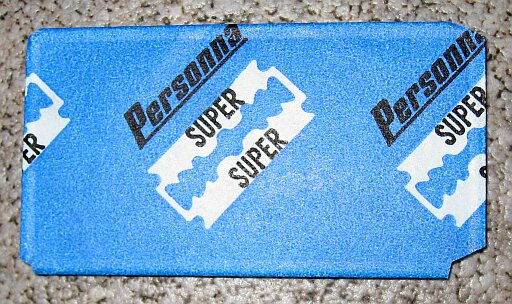
Which brings us to “kenstee” on the Pogonotomy forum. We were having a discussion about the Personna medical prep blade and he, very generously, sent me a couple in the post. This is the only Personna DE blade still made in America, all their blades for the face shaving market are made in Israel. The medical prep blade comes in two flavours, sterilised and un-sterilised, depending on their use in hospitals. Obviously one is more expensive than the other, but they are seemingly otherwise identical.
So, naturally, one of kenstee’s blades went into the Mergress for a first pass on “plus” and I have to say that it was very good, not smooth like an Iridium but not in any way draggy or rough. In fact it did a lot better than some very well known blades have done. So down to 3 for the second pass and I could not believe how super smooth the blade suddenly became. Like a light switch going on it suddenly found itself within its perfect operating envelope. Then down to 1 for the third pass and it was much the same as on 3 from a smoothness perspective.
From a cutting (ie sharpness) point of view the first pass removed nearly everything and the second pass removed what was left. A performance as good as the sharpest blades and better than many brands can achieve. I only did the third pass in the interests of science.
So if these prep blades are durable and consistent they could make a good regular shaving blade. Not quite up there with the Iridium, but better than most.
And of course the winner is traditional shaving. It gives us the infinite choice to experiment and to do what we each find works best for us.
Firstly a disclaimer, the variety of traditional shaving kit on sale is so vast that the choices are effectively infinite. And because you are different to the next man so what kit is best for you will be different, this is part of the joy of shaving this way, you can customise to your own exact personal likes and requirements. So what follows is just one man’s opinion, yours may differ substantially. Also because I am UK based this is reflected in some of the choices, however the interwebs have made us one big global community so this is not the problem it once was.
Soaps and creams.
Russian shaving creams and balms. Svoboda, Tet A Tet, Comme Il Faut, Viking, Everest, Phyto Expert
Basically creams are just soaps with water added to make them easier to use. So hard soaps are much more concentrated and can work out far cheaper per shave even if they cost more.
One of the very best soaps in the world is the Palmolive shaving stick that you can often get for under £1 in English supermarkets. Just rub it into your stubble like a big crayon then whip up into a fantastic lather with a shaving brush. The brush will then have enough charge left in it for second and third passes. This is not available in America so American traditional shavers buy it at a far higher price on eBay or bring home masses of sticks when they come here on holiday. I have done some great transatlantic equipment swaps for these sticks.
An excellent low cost cream is Ingrams which you can buy in many chemists and supermarkets. Loaded with menthol this is superb in the summer. Once again impressive value for money.
Going a bit upmarket there is Mitchell’s Wool Fat (MWF) shaving soap. This stuff is a legend and is really good for your skin. Keep it in a sealed container between shaves. Mantic59 has just done a YouTube video on how to get the best out of it. It is actually very cheap to use as a puck lasts a very long time indeed, buy online. Also it prefers a brush with a bit of backbone, like a Vulfix 404 boar/badger mix.
If you are a cream person then the step up from Ingrams is probably Body Shop Maca Root which is truly lush and is available on any high street. Sometimes they have it on offer which is a good time to stock up.
My favourite hard soap is Trumper’s Violet. This is expensive but lasts a long time. It lathers up much more easily than MWF and the violet is very soothing.
If you want 100% natural stuff then there are artisan shaving soap makers. The best respected in England is Nanny’s Silly Soap Company (online). Beware some artisan soap makers just add bentic clay to an ordinary soap to make their shaving soaps and the results are frankly rubbish.
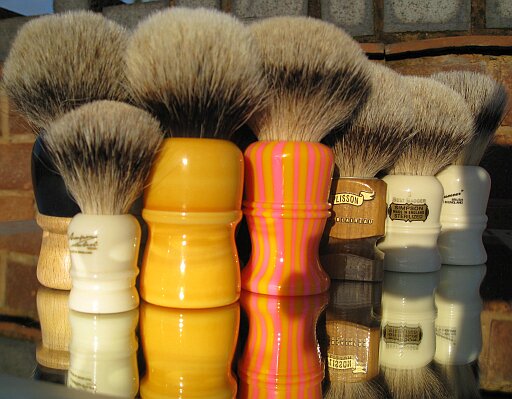
These are the most expensive part of traditional shaving. A top brush from a top manufacturer will be about £80 and upwards, but will last at least 30 years as your only brush. If you have several brushes it will last for ever. However there are far cheaper options as we will discover. Some people have large collections of brushes.
The brush has two components, the handle and the knot. With handles wood will not last as long as plastic, no matter how it is treated.The knot has very many variables which effect the way it works. One very obvious characteristic is the variation from floppiness to backbone.
Diameter at the base. This is the knot size. Too big eats cream/soap too small is more work to use.
Loft is the height of the bristles from the handle. They also go some way into the handle.
Knot shape. Flat top, bulb and fan are the main shapes. Most are a combination some way between these.
Hair variety. Badger, boar, horse and synthetic. Each behaves differently, each has followers.
Hair grade. Each of the above varieties is available in many grades and you tend to get what you pay for.
Knot density, how tightly packed the hairs are.
And you thought it was going to be simple!
Boar brushes tend to have more backbone which makes them work well with soaps. A good boar brush doesn’t have trimmed ends to its bristles and so with use they split and the brush becomes softer. This “running in” process can take several weeks and reveals the full performance of the brush. An excellent cheap boar brush is the Jaguar from Turkey, bought online for £5ish. The detail finish is not brilliant, but the brush is. After that the main brands of quality pure boar brushes are Semogue in Portugal and Omega in Italy. These are great brushes and you get what you pay for in the range. They are an online purchase. I have both. Allow £20 for a good model.
Badger brushes tend to be softer and more expensive. Nearly all the hair for them comes from China, where badgers are vermin. The Chinese graduated to making whole knots and then whole brushes.
The bargain is to buy a Frank Shaving Finest Badger (not the silvertip) for about £10 from Ian Tang in China on eBay. He has good customer service and the brushes take about 10 days to arrive, they look beautiful and are well presented. There are a range of knot sizes, shapes and lofts. I bought three of these brushes then Ian sent me two to review for my blog. The value and quality is such that they have taken the traditional shaving world by storm and with lots of positive feedback.
You can buy brushes with the retailers name on them, Trumpers, Taylors of Old Bond Street etc. Don’t. You don’t know who the manufacturer is. Better to buy one with the makers name on it. The two great, famous, British brands are Rooney and Simpsons.
Rooney are in London and make very small quantities of fantastic hand crafted brushes.
Simpsons are owned by Vulfix on the Isle of Man and make somewhat larger quantities of equally fantastic brushes across a huge range, from £20 to several hundred pounds. Models like the Persian Jar, Polo, Chubby, Milk Churn and Wee Scot are classics. I have just two Simpson’s brushes. Buy them at good prices here.
If you want to spend lots of money then Plisson in France (which Napoleon used) make exquisite bulb shaped brushes from European badger for several hundred pounds.
Horse used to be the most used brush hair before anthrax scares moved people onto boar bristle. They are fantastic brushes and have the benefit that no animals are harmed in making them, the hairs come from natural grooming.
This Turkish brush for just $2.45 is simply amazing. The biggest bargain in shaving. The detail finish is not perfect but the brush really performs.
Next up are Vie Long from Spain which you can buy here. About 10 Euros will get you an excellent “Barber Brush” (which I have), a few Euros more and you are into their very nice branded range.
Synthetic brushes are useful in that they dry out instantly so are good for travelling. There are two sorts.
Firstly there are the simple nylon strand brushes. The £5.50 Body Shop model is a perfect example.
Then there is “synthetic badger”. The theory is that these all come from Omega in Italy, no matter what brand names is on them. They are £30+ and they are excellent.
For a bit of further reading there is Fido’s shaving brush blog which you can find in the blogroll on the right here.
Razors.
Different razors perform and handle completely differently to each other, like different cars. And there are adjustable razors that are a bit like having a gearbox, you can alter the thickness of each slice of hair that they take, but the fundamental characteristics of that razor don’t change.
As ever I can’t over-emphasise that the choice is personal. What you use and how you use it is entirely up to you, the options are infinite. This is the exact opposite of what the big global shaving companies try and impose on you with their patent protected multibladed system razors.
There are two main routes you can go down, vintage razor or current production razor, let’s deal with them separately.
Vintage razors.
These are rocketing in value. But ask round friends and family and see what turns up.
With over 100 years of production there are a lot of different models to choose from but most are made by Gillette.
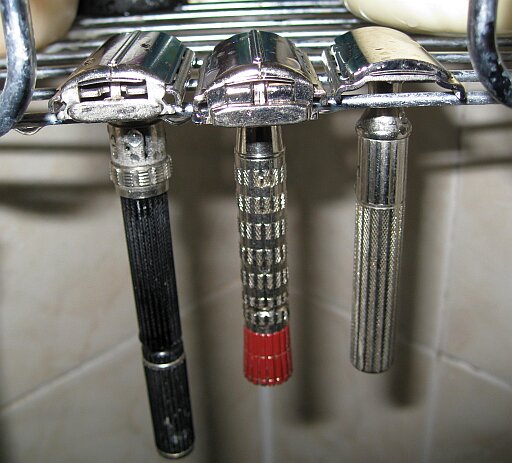
The Tech is a simple three part razor. Handle and two part head that just screw together. Often found in travel kits. Gives a very good and mild shave. Plentiful and cheap, everyone should have one.
The Super Speed is a succession of models with twist to open butterfly doors. These are the backbone of the traditional shaving revival. Mild shavers except for the model with a red tip to its handle which is a medium shaver.
The adjustables. Fat boy, Slim and Super Adjustable. Just dial in the aggression you want. Between passes or mid pass. Less common and going up in value fast.
There are plenty more but these are the main ones. Avoid old razors with toothed heads, except to collect till later.
Current production.
Start with a Weishi off eBay or a Wilkinson Sword Classic in black delrin from Boots for less than £5. These are very mild and won’t bite. Even when you are up the learning curve they are still good for a buffing and polishing third pass. There are also the Lord razors from Egypt which are less mild and which are exceptional value. Then there are the Edwin Jagger razors that have taken over from the Merkur 34C to become the “standard” traditional razor. The new Edwin Jagger head, which they seemingly co-developed with Muhle in Germany, is amazing. It feels bullet proof, as if it will never bite, yet it very effectively and effortlessly slices through the stubble. It is easy enough for beginners yet rewards the more experienced. And the razor is beautifully made, a real piece of craftsmanship and engineering for about £20.
If you want to spend more get an iKon, handmade in Thailand, buy the tooth headed model. More money still and you want the Mergress conversion of the Merkur Progress adjustable. Made in small batches you go on a waiting list, they sell out in one hour once released. Finally there is the Feather Stainless Steel from Japan which is yet more expensive.
When you get expert you might want to try a Merkur Slant Bar, probably the most powerful shaving tool known to man. So efficient that they are perfect for people with very strong beard growth and sensitive skin.
There are plenty of others like the Joris and the Goodfella but the above list is IMHO a good guide.
Blades.
These are critical, because they do the cutting and there is a lot of difference between the different brands.
The three characteristics to look for are sharpness, smoothness and blade life. Like everything else to do with traditional shaving the experience is personal and varies from person to person. Some make a Feather blade last one shave, some make it last nine. Also different blades behave differently in different models of razor. The sharper the blade the better, then it can cut your stubble with the least trauma to your face.
Gillette also makes DE blades in Vietnam, India and Brazil. These have excellent reputations but not as good as PPI.
Feather and Kai blades from Japan are immensely sharp but less smooth than PPI blades. Also they are very expensive. A Feather blade in a slant bar razor is supposed to be the absolute ultimate way to shave!
Lord in Alexandria, Egypt make several billion good quality blades a year under several brand names. Shark is the one with the best reputation. Though they are probably all the same!
Derby from Turkey are smooth and regarded as a good beginners blade, as are Personna from Israel. But you would probably be better off with a PPI blade.
If you want the best value for money then get Super-Max from Vidyut Metallics Limited in India, the world’s second biggest blade manufacturer. These are good and can be picked up at half the price of PPI blades.
One to avoid IMHO is Merkur blades from Germany, which are not as good as their razors.
Finally there is the shavepocalypse. The time when because of reducing demand the DE production lines are closed down. This has become more likely with the launch of the very low cost Gillette Guard system razor for developing countries which is targeted at DE users. This is why many traditional shavers have a stash of thousands of blades. They don’t cost much and take little space. Also they shoot up in value when a brand is discontinued as we have seen with Personna 74s, Gillette “Swedes” and now with Iridiums.
This article gives you a good place to start, but the choice out there is close to infinite, which is part of the joy of traditional shaving. So experiment, try different things and use what works best for you, even if it doesn’t work for anyone else!
Firstly a quick recap. Like many I shave with three passes, with the three razor method I select a razor for each pass that is optimised for the job. This, quite obviously really, gives a quicker and better shave and the few people who have tried it agree.
This is very definitely not the same as using an adjustable razor and turning it down between each pass. There is far more to how a razor works than just mere blade exposure. So by selecting a different razor for each pass you get to use a whole pile of characteristics that are optimised for what you are doing.
One feature of the three razor method is that the blades last a very long time because they are only being asked to do a third of the work, it is only now that I have needed to change my blades again, so I have decided to try a different set of razors as well.
This was interesting, there is definitely some merit in using different blades as well as different razors. The disappointment here was the Eclipse Red Ring which for the second pass, reducing, job was not as good as the Edwin Jagger DE89L. The revelation was the Wilkinson Sword Classic, Personna combination which could buff and polish away with gay abandon. And the Mergress was just brilliant, but then so was the 39C, both relentlessly despatching lots of stubble in very short order indeed.
So now it is time to experiment with vintage Gillette razors with the following combination:
1) Gillette long handled Super Adjustable turned up to 9 with a Kai blade. The Super Adjustable has a far wider range of adjustment than the earlier Fat Boy and Slim models and it is one of my favourite all round razors. The Kai blade is extremely sharp and in this razor it is free to do what it does best. A powerful combination.
2) Gillette red tipped Super Speed with an Astra Superior Stainless blade. The red tip is the most aggressive Super Speed but compared with the first pass razors that I have been using it is still fairly mild. The Astra is a Petersburg Products International blade so is both smooth and sharp, it could very well just be an Iridium in a different wrapper. This combination has to be very effective for a reducing second pass.
3) 1930s fat handled Gillette Tech (with the triangular cut outs) and a Super Max blade. These early Techs are not quite so mild as the later ones but they are still very benign. The Super Max blade is also not so aggressive, so this should be a good buffing and polishing combination.
After a couple of shaves this is working very well indeed, the red tipped Super Speed/Astra combination standing out in the reducing, second pass, role. This is all very interesting and great fun. Obviously my experiences and opinions are personal to me. Different combinations and methods may well work better for you. This is part of the joy of traditional shaving, we have near infinite choice to use what is best just for ourselves.
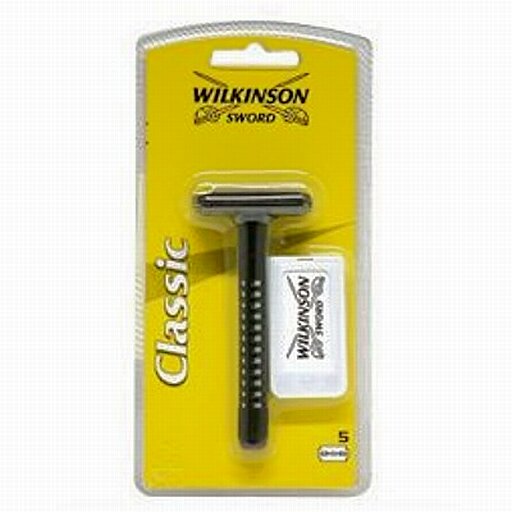
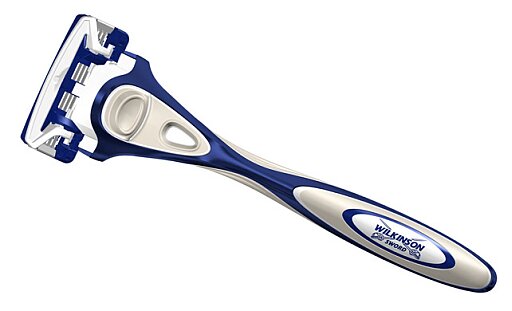
Against this background I find it amazing that they still supply traditional double edged (DE) razors, this is something that Gillette, who dominate the market, gave up in the West years ago. The razor in question is called the Wilkinson Sword Classic and it is a very nice piece of kit. Everyone should have one.
The Classic is made primarily out of black Delrin plastic with a metal rod up the handle to give it good mass and balance. The head is PTFE coated to work smoothly and is a little wider than most, as it protects the shaver from the blade’s side tabs. Inside the head the blade is located on a slot which is the best method and ensures total rigidity. The handle is quite long and has a fantastic design that allows a very good shaving grip indeed.
It is a mild shaver and, if you have mastered the basics of DE shaving technique, it just never bites. I think a lot of multibladed system razor users buy one of these to try because of the cheaper blade price so it would be nice if it came with DE shaving instructions. Also, perhaps, a lot of more experienced DE shavers look down on the Classic because it is so cheap. Their mistake.
There is a lot more to how a DE razor head works than mere blade exposure. So it is with the Classic, if you move it to an angle where it could dig in then the profile of the head seems to lift the blade edge away from your skin. This gives it a very strange feeling on your face as you experiment with the shaving angle because sometimes it feels like there is no blade there.
Then there is the price. Around £4 (or less if you shop round) with 5 blades included. This is an incredible bargain that rates alongside Palmolive shaving sticks, Super-Max blades and Turkish horse hair shaving brushes. All superb quality products that some brand snobs would miss out on just because they are ridiculously low priced.
Disclaimer. I paid for my own Wilkinson Sword Classic razor.
Gillette Super Speeds. Red Tip, Flare Tip, Blue Tip
However they were preceded by a model which is known as the 1940s Super Speed. This was made in small quantities during World War 2, from 1942 to 1945 and production was ramped up in 1946 and kept going till 1954. Interestingly this was one of the razors that saw the introduction of date codes, stamped on the bottom of the razor head, from the third quarter of 1950. These codes run from 1 to 4 for the quarter of production and have a letter for the year. 1950 was V, 1951 was W and 1952 was X, which is of interest to me because an X3 Gillette razor would be my birth razor.
Gillette Milord, 1940s Super Speed, Black Tip Super Speed
There were two anomalies of 1940s Super Speed production. The first was that when they replaced the standard nickel plating with gold plating they renamed the razor. It became the Milord. The second was the effects of the Korean war. This used up immense quantities of brass for making artillery shells, to such an extent that there was a strategic shortage of brass in 1951 and 1952 which was the worst that America had ever seen. This hit Gillette especially as their razors were mostly nickel plated brass, so they were forced to adapt to the circumstances.
This is what led to the Black Tip Super Speed, which was only made for these two years. It was made with either a steel handle (the only steel handled razor that Gillette ever made in the USA) or an aluminium handle. On both of these versions the TTO knob at the bottom of the handle was made from black plastic (unlike the later Red Tip and Blue Tip models which had painted metal TTO knobs).
Gillette Black Tip X3 birthday razor
Despite their comparative rarity, interesting history and the fact that they are one of the best shavers Gillette ever made these razors still sell for comparatively low prices. They just aren’t in fashion, which suited me down to the ground when I went hunting for my X3 birth razor Black Tip on eBay. The one I found is a steel handled version in immaculate, almost unused, condition and it cost me just $7.99 (£4.93) and like most of my vintage Gillettes it crossed the Atlantic in a jiffy bag.
Razors photographed:
B2 Super Speed Red Tip 1956
J4 Super Speed Flare Tip 1964
C1 Super Speed Blue Tip 1957
No code Milord
No code 1940s Super Speed
X3 Super Speed Black Tip 1952
Both the “no code” razors have a notched centre bar so are 1948 or later.
Regular readers will remember this idea of using the best tool for the job on each shaving pass. Starting with a Merkur slant bar to remove the maximum amount of hair in the first pass, then a Edwin Jagger DE89L for a reducing second pass and finally a Weishi for a polishing and buffing third pass. This works really, really well because each razor is being used for its optimum purpose. You don’t put a tack into the wall with a slegehammer so why polish and buff with a slant bar?
The right tool for each job
On the forums some people have criticised this (on the forums everything is attacked, it is the nature of the beast), but one thing the critics all have in common is that they haven’t tried it. But one person who has is Leisureguy who wrote an article on his blog saying that the methodology worked for him (obviously with traditional shaving YMMV always applies).
So now I have used the method for a few weeks I thought I would list the advantages.
It is a lot faster. The slant bar really crops the stubble like crazy, but you don’t have to work hard at it because you know the DE89L is to follow. Likewise the DE89L doesn’t have that much work to do, just the problem areas like jawbone and goatee. When you get to the Weishi it is just a matter of how polished do you want to be. So you are not asking much of each pass, so they can be done much more quickly.
Much better shave. My wife noticed this. You can polish away with the Weishi XTG and ATG using some vigour, knowing it won’t bite.
Less nicks and cuts. Because you are using the best tool for each pass you don’t have to work the razors hard. Just relax, take it easy and let them do their job. So they just can’t bite.
Far less trauma. Razor burn, red patches, whatever. Once again because each razor has been used in its best mode as a stubble cutter they end up having far less impact on your skin.
More fun. It is great getting to use 3 different well engineered shaving tools one after the other. Adapting to the different weights, shaving angles, balance and handle lengths is all just part of the enjoyment. Going back to using just one razor (when I travel) is boring.
Then, in the interests of science, it was time to try a different 3 razor method combination using optimised blades as well as optimised razors. This time it was as follows:
Mergress opened out to 5+ with a Feather New High-Stainless blade. Set like this the Mergress is very aggressive and the Feather is famous for being the sharpest of blades. As you can imagine this is a pretty effective stubble removal combination for the first pass.
Eclipse Red Ring with an Iridium Super blade (now a very finite resource). The Red Ring never fails to impress, the whole head design has some special magic about it that goes far beyond mere blade exposure. Teamed with the Iridium it is a very effective reduction tool indeed and is super smooth at the same time.
Wilkinson Sword Classic, the black Delrin razor, used here with a Personna Platinum blade. I have joked in the past that you cannot feel whether or not this has a blade in it, so mild is its functioning. This means, of course, that it just doesn’t bite and can be used to buff and polish with gay abandon. Not that there is much work left to do, such is the effectiveness of the two previous combinations.
Once again the 3 razor method shows its merit. A better shave, faster with less skin trauma. What more could you want?
History can teach us many lessons and this applies to shaving as much as anything else. Until the 20th century anyone who could be bothered to shave (many didn’t) used a straight edged cut throat razor, or more normally went to a barber who used one. But then King Camp Gillette achieved one of the greatest marketing coup d’états in history. Towards the end of World War One America decided to join in and sent millions of troops to the European trenches, they were each supplied with a Gillette safety razor (you can still buy these sets on eBay). Once these soldiers got home they didn’t want to know about cut throat razors any more and the word spread. Very quickly indeed the double edged (DE) razor took over. It was a sudden shavepocalypse for the cut throat but these dramatic looking razors still linger on amongst niche hobbyists.
Gillette (now owned by Procter & Gamble) makes its most money from having a monopoly in supplying blades for its patent protected razors. In the 1930s the patents on DE razors and blades ran out, so anyone could make them. Gillette responded by adding patent protected features to their razors, such as aggressiveness adjustability, but still anyone could manufacture the blades to go in them. It was not until 1971 with the two bladed Trac II that Gillette created a new patent protected blade supply monopoly.
Nowadays in the developed world Gillette are by far the dominant supplier of shaving equipment with their Mach3 and Fusion razors, however they have a problem with the developing world, where most of the world’s shavers live. About half the world’s population live on less than a dollar a day so they just don’t have the money to buy blades for Mach3s and Fusions. What they do have money for is DE shaving, which is inexpensive precisely because it is not patent protected. But DE razor blades are a commodity item that anyone can make so there is not much profit there.
Gillette have answered this conundrum with a stroke of sheer genius. They have engineered a patent protected system razor specifically for the developing world. It has just enough features to differentiate itself as a superior product to the DE razors it competes against yet clever design makes it and its blades very low cost to the end user and even lower cost to manufacture. This could very easily be the most significant event in shaving since Jean-Jacques Perret invented the safety razor in 1762. And it is called the Guard.
Gillette have very definitely set themselves up to replace DE shaving here. Here it is in their own words: “Gillette Guard is a breakthrough new shaving system designed to provide a safe, high-quality shave at an affordable price for more than one billion men in emerging markets who today shave with double-edge razors.” This is a huge threat for Western DE shavers, we rely on the huge mass of DE shavers in the developing world to assure our supply of razor blades. If the developing world does as Gillette wants and shifts over to the Guard then it could be shavepocalypse time for us.
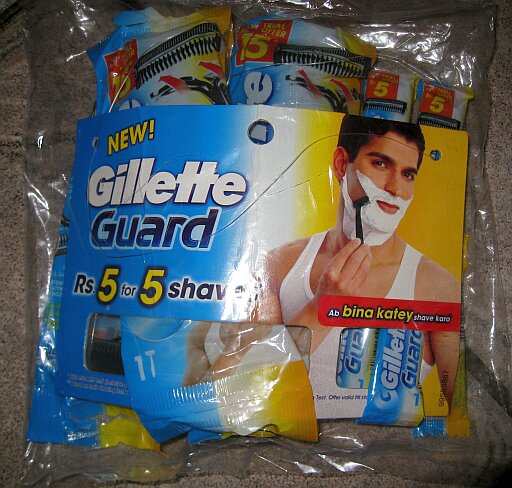
Obviously the Gillete Guard merited a closer look so as soon as they (inevitably) came up on eBay I ordered a pack containing four razors, each with a blade and eight additional blades. All of this cost me $6 (£3.72). And now I have had a good chance to play with them. They are masterpieces of engineering design and production. Every fraction of an ounce counts when you are going to make billions of something and when price is one of the main drivers. So the Guard has, according to Gillette, 80% fewer parts than a Western system razor and it is evident that it is constructed just heavily enough for permanent use and not to be a disposable.
The razor itself is just two pieces of plastic (a top and a bottom) glued together, the tuning fork ends splay out to form the hinge and are squeezed to get the cartridge on and off. You couldn’t make it any simpler. The cartridge is just one piece of plastic with 4 little hot weld on it where the tiny sliver of steel that makes up the single blade is located. There is so little steel in this that it wouldn’t surprise me if Gillette can make one of these shave heads for less cost than they can make a DE blade. So just four components are needed to make up the entire shaving system.
Now lets look at the features and benefits that Gillette hope are going to make hundreds of millions of men make the switch over from DE to the Guard. Here they are, once again in Gillette’s own words:
Comb Guard: The revolutionary Comb Guard feature, first time ever on a razor, helps to automatically manage skin bulge on the face and serves to flatten the skin for a safe shave while minimizing the risk of nicks and cuts. Comb Guard is designed to reduce cuts and irritation, even when you press the razor while shaving. Whereas a double edge blade might cut, if you press it slightly hard against the skin.
No clogging: The blade on Gillette Guard can be rinsed conveniently, enabling cut hair to be easily washed away. Thus, facilitating the consumer to experience a more hygienic shave.
Swivel head: Gillette Guard has a flexible, swivel razor head that helps in maneuvering around the curves on the face and neck during a shave. The swivel head of Gillette Guard enables the consumer to cut hair in the area under the nose – a fairly difficult area for a user of double-edge blade to shave because the ordinary razor does not have a swivel head.
Ease of cartridge change: The single squeeze cartridge loading system of the Gillette Guard, a simple squeeze two-point intuitive docking – is an innovation in design that makes it much easier to change the blade of a Gillette Guard with less steps compared to fitting a double-edge blade to an ordinary razor.
Enhanced glide while shaving: The grooves on the cartridge of Gillette Guard above the blade helps to hold in water during the shave in order to enhance the razor glide. Whereas Double edge razors have no such provision.
User-friendly handle design: The Gillette Guard handle has also been designed to meet the needs of the consumer during and after shaving. The ergonomically designed handle enables the user to experience ease of maneuverability during shaving. This ribbed and lightweight handle will help the consumer to have better control while shaving, even when it is wet. The broader and thicker end of the razor handle is the rinse grip feature that enables consumers to hold it vertically while rinsing the razor. There is also a “hang hole” at the end of the razor handle that enables consumers to hang it to dry after shaving.
I have to say that I hope that Gillette haven’t patented the comb guard and the grooves above the blade. In their marketing spiel above they say “first time ever on a razor” and “Double edge razors have no such provision” yet if you look at the pictures of my 70 year old Eclipse Red Ring DE razor you can see what to me look like the same features.
So how does the Guard shave? The first thing you notice is that the handle feels very long, this must have been done deliberately as a differentiator from DE razors. The head swivels nice and freely to adopt the position that Gillette’s boffins want it to. Then it shaves quickly and easily, there is no getting away from the fact that it is ridiculously easy to use compare with a DE razor. But it is not anywhere near as fast as the Hydro system razor I used the other day. But then the shave head doesn’t clog up anything like as easily with the Guard. The first shave gave an OK result so I lathered up for a second pass and got an acceptable shave. Not DE good, just acceptable. It gave me two very, very small weepers in the goatee area but these were really nothing.
Just now an Indian Rupee is 1.4 British pennies, 2.3 American cents and 1.6 Euro cents. The Guard razor with one blade is priced at 19 Rupees with a 15 Rupee trial offer but obviously it will be discounted by traders, the blade cartridges (where Gillette will make their real money) are 7 Rupees with a 5 Rupee trial offer and Gillette are saying that they are good for 7 shaves. So one Rupee or less per shave, which is a lot more expensive than DE razors but a whole continent cheaper than the multibladed system razors that are prevalent in the West.
So will Gillette succeed with the Guard? With such an excellent product and with the normal Gillette marketing steamroller the answer has to be yes. The real question is how far will they succeed. Obviously they will roll this out in the Indian subcontinent, China, Africa, much of Asia and the former Soviet states. There will be pockets where the price is still too high, but generally it will be affordable. The Guard could very quickly and easily become the most used razor on earth, which must be what Gillette are planning. It is just a matter of time scale.
Oh no, I can hear you thinking, Bruce has gone over to the dark side. But don’t worry, there is some method in my madness. The two big global system razor companies, Procter & Gamble (Gillette) and Energizer (Schick and Wilkinson Sword) make their huge profits by patenting features on their system razors which their marketing people can try and convince us are benefits. These patents give these big global companies monopolies in supplying the very expensive blade cartridges needed for their razors. But patents run out, so each of these companies is forced to bring out a succession of new models with new patents in them. Then their marketing people have to convince us that the new patented ideas are worthwhile.
Of course these marketing people are massively successful (rivalled only be De Beers and the global diamond monopoly) and many hundreds of millions of men around the world are perfectly happy to pay enormous prices on an ongoing basis for these patent protected system razor blade cartridges. In the West they are far more popular than the double edged (DE) safety razors that this blog is about. Yet the DE razor is both hugely better and hugely cheaper. It just doesn’t have the marketing billions behind it.
So now, in the patent cycle, the time has come for Energizer to try and sell us more new features in a brand new system razor, this one they are calling the Hydro. Inexplicably they sell this under two different brand names in different sales territories. In some places it is a Schick and in some places a Wilkinson Sword. This must cost them many millions every year in lost marketing synergies and in my opinion epitomises why they are number two and are likely to remain that way. Marketing is far more important than the product with these razors.
Part of the marketing billions is spent with PR companies, whose job it is to reach people who write in the media. And these days that means bloggers as well as conventional print journalists. Rightly so, my Bruce on Games blog had over 100,000 readers a month, so reached an audience larger than a lot of specialist print magazines do. All of which means that the PR companies employed by Procter & Gamble and Energizer have me as a target as a “shaving blogger”. If they actually read my blog they would realise that I see them as being the dark side, which might dampen their enthusiasm.
Hence I received a stream of emails from the London PR company representing the Hydro inviting me to an event: “I was just wondering if you would like to join us for our special breakfast on Monday to unveil the biggest launch in Wilkinson Sword’s history. We will also have a pop up barbers shop should you wish to try the new range and have a professional shave. The lovely Nick from Shaving Shack is coming along.”. How could I refuse?
Everyone in traditional shaving knows that the best ever Wilkinson Sword razor was the legendary “Stickie” DE, which was my first ever razor. Would this PR company have one of these for comparison? Hardly likely.
To me the defining feature of a system razor is the hinge, everything else is just marketing. The hinge is supposed to keep the angle of the blade against the face constant, which makes it easier to use. So the shaver can shave with their wrist and use long strokes. A DE shaver has to manage the angle of the blade themselves, which entails shorter strokes, not using the wrist and a brief learning curve. But it gives the shaver far more control over what the razor is doing.
So what is the Hydro all about then? What “features” have they come up with that they can patent and which their marketing people can convince us are benefits? They say the razor was 6 years under development. In this time they came up with 2 main innovative features. The first is a bump that runs along the blade just behind the edge to prevent it digging in to the skin. These are called “Skin Guards”. The second feature is the replacement of the (possibly unnecessary) lubricating strip with a small tank containing a water activated lubricating gel. This is called the “Advanced Hydrating Gel Reservoir”.
Interestingly there are two versions of the Hydro. A 3 blade and a 5 blade (handily either cartridge will work on either handle). You can see exactly what has gone on here. A lot of Gillette customers haven’t upgraded from their Mach 3 razors to the Fusion, presumably they think that 3 blades are enough. They have a point because anything more than 3 blades tends to be very clunky and the cartridges sell for even more extortionate prices. So Energizer need to compete against both the Mach 3 and the Fusion if they are to switch customers over. On the Hydro 3 packaging there is a sticker that says “Shaves Better Than Mach 3″, which gives the game away.
On the Hydro 5 you get the bonus feature of an “Advanced Hydrating Gel Reservoir” that clicks back to make the head less clunky. This is called the “Flip Trimmer” and is handy for allowing the blades to reach the stubble under your nose. Unfortunately clicking it back stops the cartridge hinge working, so the blade has its pivoting action hindered or stopped completely, which goes against the fundamental mechanism and philosophy of these razors.
So let’s look at the system razor market. Basically Procter & Gamble own it with the Gillette Fusion and Mach 3, they must be very disappointed that so many of their customers have stuck with the Mach 3, but they are still making big profits from them, it is just that those profits are less big than if the customers “upgraded” to the Fusion. Energizer are a fraction of the size with their Schick/Wilkinson Sword Quattro, introduced in 2003, which is a bit clunky to use. Then there is the plucky young upstart King of Shaves with their Azor razor which is fundamentally cheaper and easier to manufacture because it uses a simple hinge in the handle for its pivoting mechanism.
This makes the Hydro a critical product. They could end up as the meat in the sandwich between the more expensive Fusion and the cheaper Azor. Or they could take market share out of both. When the Hydro was launched in America it had a brief honeymoon as the best selling razor in the market. However this party was soon rained on when Gillette launched (with a massive budget) a new version of the Fusion with more “features” called the ProGlide. In the UK the ProGlide will be launched early next year in what Procter & Gamble are promising will be the biggest consumer launch of the year. So for every pound that Energizer have spent marketing the Hydro, Procter & Gamble might spent five pounds marketing the ProGlide. And when it comes to shaving the customers buy what the marketing people tell them to buy, so this bigger spend will be everything. And of course the reason they have so much marketing spend is because of the huge profitability of those patent protected multibladed cartridges. The shaver pays for all those TV adverts and celebrity fees every time they shave.
Now I thought I would do something radical and look at the real technology of these razors. Gillette use a simple pin pivot just behind the razor head, Schick/Wilkinson pivot using a semi circular track which puts the pivot point somewhere about the surface of the skin. This latter mechanism has to be better because the head is more free to follow the face’s profiles. The Azor uses a handle hinge so the cartridge moves through an arc, rather than a pivot, which to me looks a less pure, but cheaper, engineering solution. Not that you need any pivot at all as billions of double edged shavers have proven over the last 100+ years.
The next big difference is that the individual blades on the Fusion and the Azor are mounted on springs, so move up way from the cutting zone when subject to any pressure. When you consider that these blades have zero exposure and are buried within a plastic cartridge it strikes me that this could be counter productive, it could work towards preventing the blades from actually giving a close shave. Schick/Wilkinson Sword on the other hand mount their blades rigidly and rely on their “Skin Guards” to make their razor as foolproof as their competitors’ razors.
So if these multibladed cartridge based system razors are a good idea, which to me is a dubious proposition, then Schick/Wilkinson Sword seem to have technological superiority in two very key areas. All in my humble opinion, of course.
Now we come down to what they are like to use. I lathered up using a brush and Williams shaving soap then used the Hydro 3 on one side of my face and the Hydro 5 on the other side of my face. As you would expect from system razors they were ridiculously easy to use and very, very fast with no sign of even the slightest razor burn or nicks. A Chimpanzee could easily use one of these. They both clogged up very quickly and needed frequent rinsing, just like all multibladed razors.
The “Advanced Hydrating Gel Reservoir” was a bit too much, making the face all gloopy, other users report that it is more successful with the lower grade lathers you get with an aerosol gel or foam. And it didn’t work till it had a couple of seconds exposure to moisture, so it would be best to dip the razor head in the water before using it. There was no noticeable difference in the efficacy of the Hydro 5 over the Hydro 3, just that the 5 was a bit more clunky to use. As ever with a system razor the shave was not particularly close so I lathered up again and finished the job off with my Eclipse Red Ring, a 70 year old double edged razor.
Energizer are taking advantage of their huge investment in launching the Hydro brand to piggy back a whole range of men’s grooming products. Two aerosol gels (sensitive and moisturising) and a foam, and of more interest to the traditional shaver a shaving cream and a balm. However the cream contains Methylparaben, Propylparaben and Triethanolamine whilst the balm contains all three of these plus Ethylparaben. I have written about these chemicals before.
So who are the Hydro 3 & 5 razors for? Anyone who wants a quick and easy (but not the best) shave who is prepared to shell out a fair bit of money every year on multibladed cartridges. So that is most men in the developed world. Of the available system razors it is probably the best of the bunch just now. The Hydro 3 is the better of the two because it is less clunky and is cheaper to buy and run. But obviously I would recommend that anyone climbs the short learning curve to use a double edged razor instead.
And what am I going to do with my freebie Hydro razors? I keep a Gillette Mach 3 in the shower for shaving bits that aren’t my face. It looks like the Hydro 3 may replace this as it seems to be the better razor. A bit more comparison is needed first, though. The Hydro 5 will be kept for when I need a passable, high speed shave and haven’t the extra couple of minutes needed to do it properly with a double edged razor.
Freebies received in the making of this article:
Bacon rolls.
Fruit juice.
Shave by grooming expert.
Hydro 3 razor with 2 blades
Hydro 5 razor with 2 blades.
Pack of 4 Hydro 3 blades.
Pack of 4 Hydro 5 blades.
Hydro shaving foam aerosol.
Hydro sensitive gel aerosol.
Hydro moisturising gel aerosol.
Hydro shave cream.
Hydro after shave balm.
This is what men did to shave before safety razors, which is why most of them grew a beard. It takes a lot longer, you are more likely to cut yourself and maintaining the blade edge takes a lot of time. The upside is that it is macho and will impress the women, there is less environmental impact and you are safe from the impending shavepocalypse that the big global shaving companies are going to bring down on us.
Frankenrazor. Feather Portable with Lord, Edwin Jagger, Lux, Gillette and Feather handles
Frankenrazor is a term used in the shaving community to describe a razor that is made up of bits from one razor and bits from another razor, so what you end up with is a composite of the razors it was made up from. Making a frankenrazor is easy because most three part razor handles can be interchanged, so you would have the upper and lower parts of the head taken from one razor and the handle from a different razor.
Frankenrazor. Feather Portable with Lord, Edwin Jagger, Lux, Gillette and Feather handles
As you can see from the photographs I have an excellent Feather Portable razor from Japan, however the Feather handle, on the extreme right, is a bit too small and weedy. The razor works much better with the excellent Lux stainless steel handle from Poland fitted to it. But were I to want to I could instead use the Lord handle from Egypt on the left, the Edwin Jagger DE89L handle next to it or the Gillette Tech aluminium handle to the right of the razor. They all fit and each one completely changes the balance and feel of the whole razor. If you want to further customise your razor you could have a handle custom made by someone like iKon.
Frankenrazor. Feather Portable with Lord, Edwin Jagger, Lux, Gillette and Feather handles
So far so good, mixing and matching can make a better razor. The problem comes when people do this with valuable vintage razors. And they do. If someone has an early Gillette model with a damaged head and a different model with a damaged handle they can put the undamaged bits together to make a frankenrazor. These come up on eBay and as the real thing could be worth hundreds of dollars you can see that this has the potential to be a profitable scam. So take care, if you are buying an old razor first check it out against the photographs on Mr Razor.